
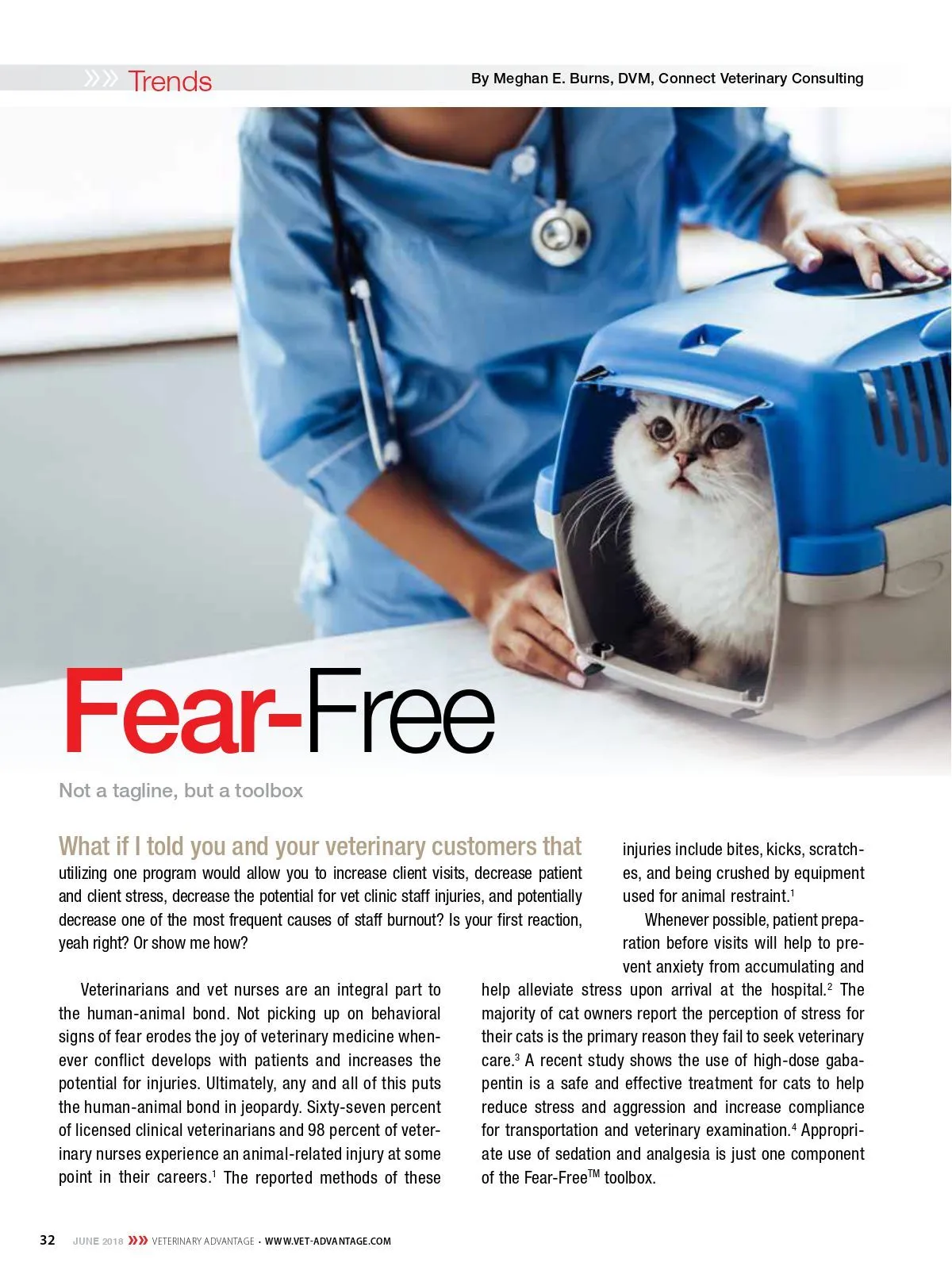
The Fear Free program isn’t a tagline, but a toolbox.
What if I told you and your veterinary customers that
utilizing one program would allow you to increase client visits, decrease patient and client stress, decrease the potential for vet clinic staff injuries, and potentially decrease one of the most frequent causes of staff burnout? Is your first reaction, yeah right? Or show me how?
Becoming a Fear-Free certified practice does all those things, and more.
Veterinarians and vet nurses are an integral part to the human-animal bond. Not picking up on behavioral signs of fear erodes the joy of veterinary medicine whenever conflict develops with patients and increases the potential for injuries. Ultimately, any and all of this puts the human-animal bond in jeopardy. Ultimately any and all of this puts the human-animal bond in jeopardy. Sixty-seven percent of licensed clinical veterinarians and 98% of veterinary nurses experience an animal-related injury at some point in their careers.[1] The reported methods of these injuries include bites, kicks, scratches, and being crushed by equipment used for animal restraint.[1]
Whenever possible, patient preparation before visits will help to prevent anxiety from accumulating and help alleviate stress upon arrival at the hospital.[2] The majority of cat owners report the perception of stress for their cats is the primary reason they fail to seek veterinary care.[3] A recent study shows the use of high-dose gabapentin is a safe and effective treatment for cats to help reduce stress and aggression and increase compliance for transportation and veterinary examination.[4] Appropriate use of sedation and analgesia is just one component of the Fear-FreeTMtoolbox.
[1] Nienhaus A, Skudlik C, Seidler A. Work-related accidents and occupational diseases in veterinarians and their staff. Int Arch Occup Environ Health. 2005;78:230–238.
[2] Yin, S. Low Stress Handling, Restraint and Behavior Modification of Dogs and Cats: Techniques for Patients Who Love Their Visits; CattleDog Publishing: Davis, CA, USA, 2009.
[3] van Haaften KA, Forsythe LRE, Stelow EA, Bain MJ. Effects of a single preappointment dose of gabapentin on signs of stress in cats during transportation and veterinary examination. J. Am. Vet. Med. Assoc. 2017 Nov 15;251(10):1175-1181.
[4] Pankratz KE, Ferris KK, Griffith EH, Sherman BL. Use of single- dose oral gabapentin to attenuate fear responses in cage-trap confined community cats: a double-blind, placebo-controlled field trial. J Feline Med Surg. 2017.